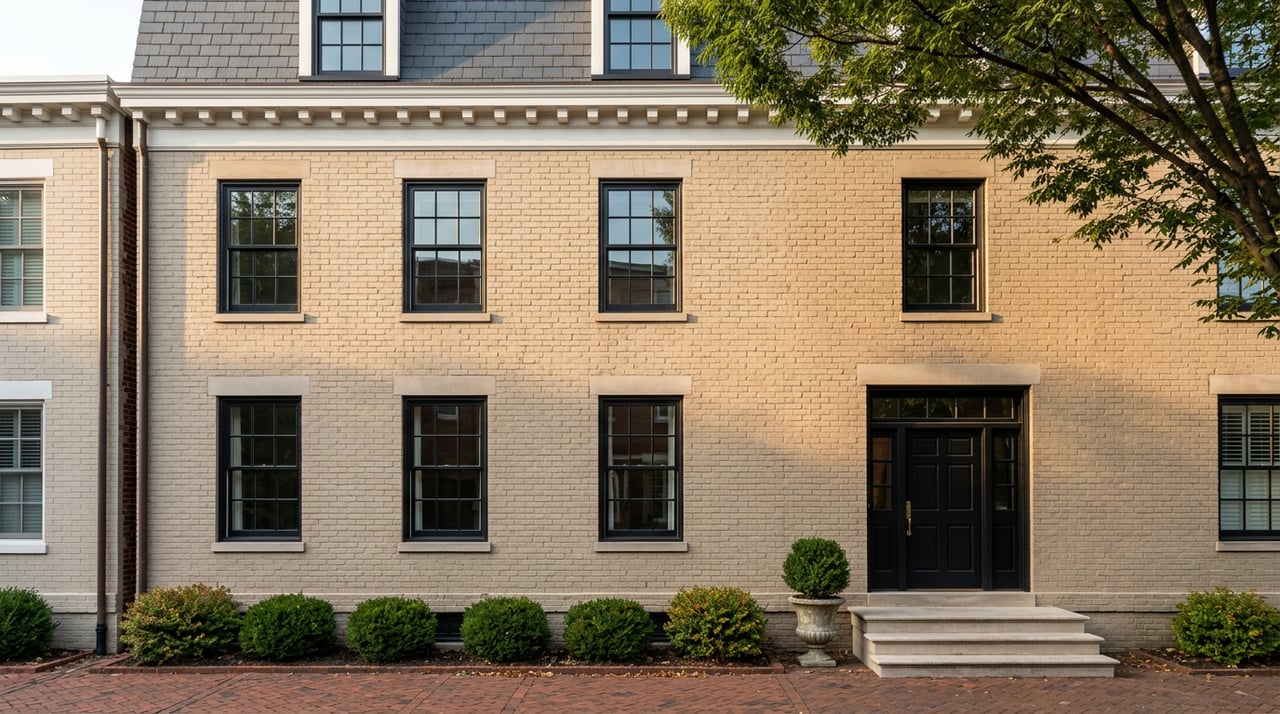
New Old Town Restaurants Cluster Along the King Street Pedestrian Corridor
September 3, 2026
September 3, 2026
At least ten restaurants and cafes have opened, reopened, or announced in Old Town Alexandria over the past year. That is not a normal year. A normal year sees two or three. What's harder to see from the sidewalk is that their addresses line up with the pedestrian corridor. The Commodore, The Majestic's relaunch, Maman, Floriana, Finn & Fire, Grazie Nonna, For Five Coffee: nearly every one of them landed inside the same six-to-eight block stretch between Market Square and the Old Town North waterfront. That stretch is the exact footprint of a pedestrian zone the city finished building on October 1, 2025, when it permanently closed the 200 block of King Street to cars.
The restaurant boom and the ordinance are the same story. Most residents have clocked one or the other, the new burger place on Lee Street, the farmers market's odd new location off Royal Street, without connecting them. They're connected. And with the neighborhood's fall calendar about to run through that same reshaped corridor for the first time, it's worth understanding the mechanism before you plan your next few Saturdays around it.
King Street's car-free zone didn't arrive all at once. It came in three deliberate steps, each one tested before it became permanent.
| Block | Pedestrian since | Made permanent |
|---|---|---|
| 100 block of King St | May 2020 (pilot) | October 2021 |
| Unit block and The Strand | Memorial Day weekend 2022 (pilot) | November 2022 |
| 200 block of King St | November 2024 (pilot) | October 1, 2025 |
The 200 block was the hardest sell. City Council ran it as a two-phase pilot, first through the 2024 holiday season, then for a six-month stretch from March through September 2025, specifically to gather data before deciding anything permanent. The numbers that came back settled it. Traffic studies found pedestrian volumes outnumbering vehicles by five to twelve times at the three intersections the city studied. A survey of 1,842 respondents came back 87 percent in favor, up sharply from 55 percent the year before, and business support on the block itself rose from 7 of 16 owners to 12 of 16. Council voted 7-0 on September 13, 2025, and the permanent version started that October 1.
The tradeoff was real. The city gave up 16 metered spaces and one short-term visitor spot, roughly $50,000 a year in meter revenue, and traffic on parallel streets like Cameron, Prince, and Duke rose 32 to 35 percent as drivers rerouted. Vice Mayor Sarah Bagley pointed residents toward the fix during the debate: within a six-minute walk of the pedestrian zone sit 13 public parking garages. The city has been working since to get signage pointing people toward them.
What that vote actually did, mechanically, was remove the last gap. Before October 2025, Old Town had two separate car-free islands, the 100 block and the Unit block/Strand, with a car-carrying block sitting between them. Now Market Square connects to the waterfront in one unbroken walk. Visit Alexandria's president and CEO, Todd O'Leary, endorsed the closure in writing before the vote, calling the existing pedestrian blocks a defining feature of Old Town and predicting the 200 block would help build the critical mass needed to energize that stretch of the city. Ten new restaurants in a year suggests he wasn't wrong.
Restaurant groups don't need a sign to read a foot-traffic map. Look at where the class of 2026 actually put down roots.
Every one of those addresses sits inside or directly feeding the corridor that only became a single continuous walk in October 2025. That clustering is notable, though it does not establish why operators chose those sites. A restaurant on the 200 block used to compete with cars for curb appeal. Now it competes for foot traffic on a block where studies show pedestrians outnumber vehicles by five to twelve times.
The other change nobody planned around the restaurants is happening at the same time for an unrelated reason. The Old Town Farmers' Market, which has operated continuously on Market Square since 1753 (George Washington himself sent produce down from Mount Vernon to be sold there), relocated in January 2026 to the 100 block of North Royal Street and the courtyard at Tavern Square. City Hall and Market Square are mid-renovation, a project expected to run two to three years, and the market had to move to keep its Saturday streak alive.
The new site sits one block off its historic home, close enough that the market's rhythm barely changed: still every Saturday, still 7 a.m. to noon, still more than 70 vendors selling produce, baked goods, flowers, and prepared food. Free parking during market hours is available in the Tavern Square garage at 418 Cameron St. and the Courthouse Square garage at 111 S. Pitt St. What's changed is the geography of a Saturday routine. A market run that used to end at Market Square now starts a block north of it, which means it feeds directly into the same expanded pedestrian loop instead of requiring a street crossing to reach it. The market moved for renovation reasons. The timing happens to line up with the exact corridor the city spent five years building.
Restaurant Week wrapped on August 23, and the last of the summer Pipes and Drums concerts played Waterfront Park on August 21. The Around the World Festival took over Oronoco Bay Park on August 29 for its tenth year. That's the summer accounted for. What comes next is the first fall to run entirely through the newly closed loop, and it's stacked with three consecutive weekends worth planning around.
September 13 brings the Mount Vernon 10-Miler and 5K, part of the city's America's 250th programming, with a 7 to 11 a.m. window, mansion views, and the usual medal-shirt-beer finish line combo. September 19 is Alexandria Oktoberfest at John Carlyle Square, 11 a.m. to 6 p.m., free admission, pet-friendly, with a beer garden and the Mr. and Mrs. Oktoberfest costume contest that regulars know to prepare for. The following weekend, September 26 and 27, the Annual Art Festival returns to the same square, 10 a.m. to 5 p.m., free, with a juried selection of painting, sculpture, jewelry, and textiles from artists working across the country.
None of that calendar existed on a single connected walk two years ago. Now it does, and the restaurants that opened this year are clustered along and near it.
The lesson isn't that Old Town got a few new restaurants. It's that a five-year infrastructure decision, made block by block and justified by traffic counts nobody outside city planning usually reads, quietly rewrote where operators want to be and where a Saturday morning naturally leads. If you've lived here through all three phases, October 2025 was the month your own walk got longer without you moving an inch.
Capitol Z Homes is based right here in the neighborhood, and we track these shifts because they shape more than dinner plans. If you're curious what a changed walking radius and a busier corridor mean for your own Old Town property, get your free home valuation from our team. We know these six blocks because we walk them too.
Trust, Reliability and Knowledge. We are very passionate about the relationships we build and will always work relentlessly on your behalf to help you achieve your real estate goals.